For decades, a coil has been primarily viewed as an element that generates a magnetic field. But what if, beyond the simple concept of inductance, there is a much more complex system hidden within it?
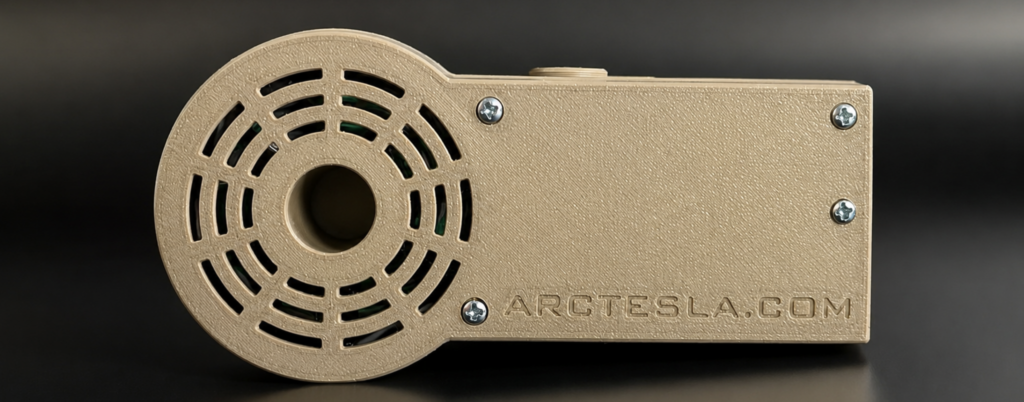
PHOTON-1: An Experimental System for Studying Standing Waves, Radio-Frequency Radiation, and Environmental Feedback Response
Introduction
Modern electronics often consider a coil as a simple component — an inductor that converts electrical energy into a magnetic field. However, at high frequencies, a coil becomes a much more complex system where distributed parameters begin to play an important role: electric fields, capacitive coupling, phase relationships, and resonance phenomena.
This approach became the foundation for the development of the experimental device PHOTON-1.
PHOTON-1 is an experimental platform designed to study the interaction between high-frequency electromagnetic fields, standing waves, and the feedback response of the surrounding environment.
The Main Concept of the System
The operating principle of PHOTON-1 is based on the idea that a high-frequency coil is not only a source of magnetic fields, but also a distributed electromagnetic structure capable of forming complex resonant modes.
Under certain conditions, the system can produce:
- standing electromagnetic waves;
- distributed electric fields;
- resonant interactions between system elements;
- radio-frequency electromagnetic radiation.
In this approach, the coil is considered not simply as an inductive component, but as an active element capable of interacting with the surrounding electromagnetic environment.
Wide Spectrum and Field Control
One of the key features of PHOTON-1 is the ability to explore a wide range of frequency operating modes.
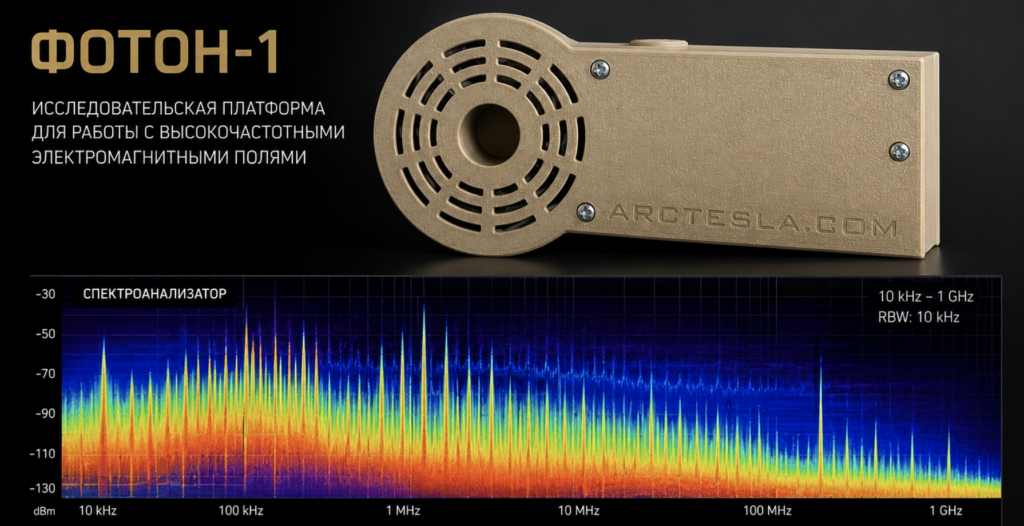
By changing excitation parameters, coil geometry, and system configurations, different spectral components of the generated radiation can be studied, as well as their influence on the formation of feedback processes.
Spectrum analysis makes it possible to observe the frequency distribution within the system and investigate the interaction between different harmonic components.
The Concept of Environmental Feedback Response
One of the main ideas behind the PHOTON-1 project is the study of the feedback relationship between the generated electromagnetic field and the surrounding environment.
When an electromagnetic field interacts with an external system, a portion of the energy may return to the resonant structure in the form of a modified response.
This process can be viewed as a dynamic interaction:
field generation → interaction with the environment → feedback response → change in the energy state of the system
Studying these processes allows researchers to explore the behavior of complex electromagnetic systems under different conditions.
Research on Biological Samples
One of the potential research directions of PHOTON-1 is the investigation of interactions between high-frequency electromagnetic fields and biological samples.
The hypothesis behind this research is that certain electromagnetic exposure modes may influence the state of biological systems and help reveal hidden structural changes.
One of the future research directions is the study of whether specific electromagnetic interactions can help identify changes associated with inflammatory processes that may exist in inactive or hidden states.
This field requires controlled experiments, precise measurements, and scientific validation of observed effects.
Conclusion
PHOTON-1 is an experimental platform for studying high-frequency electromagnetic processes, with a focus not only on signal generation but also on the interaction between the system and its surrounding environment.
The investigation of standing waves, broadband radio-frequency radiation, and feedback responses may provide a deeper understanding of the processes occurring inside resonant electromagnetic structures.
The next stage of the project includes experiments with different coil geometries, spectral characteristics, and studies of interactions with biological models.
Recommendations for Experimental Session Duration with PHOTON-1
First Session
During the first use of the PHOTON-1 device, or after a long break, it is recommended to begin with a short session lasting no more than 15 minutes.
Initial observations should be performed carefully, monitoring the individual response of the body and overall well-being.
Any interaction between high-frequency electromagnetic fields and biological objects may produce individual responses; therefore, the duration and operating mode should be adjusted gradually.
Initial Stage of Application
Within the framework of an experimental approach, it is recommended to begin research with areas associated with natural regulation and metabolic processes of the body.
The first session may be performed by placing the device’s emitter in the area slightly above the sacrum.
Subsequent experiments may include studying the response of different areas of the body, including regions corresponding to:
- the liver;
- the pancreas;
- the intestines;
- other areas of research interest.
Local application to specific areas may also be studied as part of experimental observations.
Exposure Time Limits
During the first days of use, it is recommended to limit the total operating time of the device:
- up to 15 minutes per session;
- dividing the time between several areas if necessary.
For example:
- 5 minutes — first research area;
- 5 minutes — second area;
- 5 minutes — additional observation area.
If the device is well tolerated, the session duration may be gradually increased:
- up to 20 minutes;
- up to 30 minutes;
- and potentially longer periods.
Increasing exposure time should be done gradually with continuous monitoring of the body’s response.
Monitoring the Body’s Response
If unwanted sensations or significant discomfort occur during use, it is recommended to:
- take a break for several days;
- reduce the duration of the next session;
- continue observations after normal well-being is restored.
Individual responses may vary, therefore selecting the optimal operating mode is part of the experimental process.
Long-Term Studies
If no adverse reactions are observed, the session duration may be increased after an adaptation period.
Long-term observations using PHOTON-1 and ARC-21 systems may provide additional information about possible changes resulting from regular application.
Particular interest is focused on studying the adaptation processes of biological systems to long-term exposure to electromagnetic fields.
Regular Observation
For obtaining objective results, it is important to conduct studies regularly and record observed changes.
Some processes may develop gradually and require long-term observation and data collection.
Long-term studies lasting several months or more may provide additional information about the interaction between resonant electromagnetic systems and biological objects.
PHOTON-1 is an experimental system designed to study the interaction between high-frequency electromagnetic fields and biological objects. All observations require further investigation, measurement, and scientific validation.
Technical Design of PHOTON-1
PHOTON-1 is designed as a compact autonomous experimental system with an integrated power supply and adjustable operating parameters.
The device operates from a rechargeable 18650 lithium-ion battery, allowing independent operation without a direct connection to an external power source.
For battery charging, the system is equipped with a USB Type-C charging input and a built-in charging indicator that allows the user to monitor the charging process.
The internal power architecture is designed to provide stable operation of the high-frequency generation system and maintain consistent experimental conditions.
One of the key features of PHOTON-1 is the ability to adjust the output power and resonant operating modes. This allows researchers to explore different excitation conditions, study coil behavior, and analyze changes in electromagnetic field distribution.
The combination of autonomous power, adjustable parameters, and resonant control makes PHOTON-1 a flexible platform for experimental research in high-frequency electromagnetic systems.